AI for Performance Reviews: Write Honest, Specific Reviews (2026)
Use AI to write performance reviews that are honest, specific, and defensible — in 90 minutes. The Evidence-First Workflow turns your raw notes into reviews your reports can actually act on.
Bad performance reviews quietly damage careers — and most managers don't realize they're writing them. Not because they're lazy or don't care. Because the gap between what you observed over six months and what you can articulate in a 90-minute writing session is enormous. Generalities slide in. Evidence gets compressed. Development feedback becomes a vague aspiration. The person reads it, files it away, and learns nothing.
The cost is real: high performers who feel unseen start looking elsewhere. People who needed a clear signal get a muddled one and don't change. And the manager is left with a review that doesn't reflect what they actually know about the person's work.
"Strong communicator." "Exceeded expectations." "Needs to be more proactive." None of these tell the person anything they can act on — and none of them protect you if the review is ever reviewed by HR.
AI doesn't solve the performance problem. It solves the articulation problem — turning the raw evidence you actually have into specific, fair, useful documentation. The Evidence-First Review Workflow takes one afternoon and five steps. A process that used to take three or four hours — and still felt incomplete — runs in 90 minutes when the structure is right. If you want a broader foundation of prompts to draw from, the best AI prompts for executives covers the full toolkit.

The gap between what you observed and what you can articulate is where most performance reviews fail
Step 1: Dump Everything You Have
Before you write a single sentence, do a brain dump. Everything you remember. Don't edit. Don't organize. Just paste.
If you're not sure what to include, work through these five categories:
- Projects and deliverables — what did they own, ship, or lead? Specific names and outcomes, not just departments or themes.
- Moments that stood out — a meeting where they stepped up, a deadline they handled well (or badly), a decision they made that you noticed. If you remember it six months later, it belongs here.
- Feedback from others — anything you received in a 360, from a peer, from a client, from another leader. Even informal.
- 1:1 notes and written records — anything you logged, forwarded to yourself, or captured in a doc. Even fragments.
- Goals and targets — what were they supposed to accomplish this period? What happened against those specific targets?
The more specific your input, the more specific the output. Vague notes produce vague reviews no matter what you ask the AI to do with them.
If AI is already integrated into your tools
If your organization uses Microsoft Copilot, you can pull email threads and Teams conversations directly — ask it to summarize your interactions with this person over the review period before you start your brain dump. The same applies to any AI layer built into your internal messaging or email (Google Workspace Duet, Slack AI, and similar). Use it to surface exchanges you've forgotten. The richer your raw input, the sharper the output in Step 3.
Paste this prompt:
"I'm preparing a performance review for [name/role] covering [time period]. I'm going to give you a dump of raw notes, observations, and examples. Don't analyze yet — just acknowledge receipt and ask me if there's anything else before we start.
Here are my notes:
[paste everything you have]"
Let it ask clarifying questions. Usually it will prompt you to add: peer feedback you've received, any specific incidents, how they performed against their goals. This surfaces things you'd otherwise miss.
A note on data privacy
Most corporate HR policies restrict pasting identifiable employee data into public AI tools — including the free tiers of Claude and ChatGPT. Check your organization's policy before you start. Two options: use your organization's enterprise AI instance, or anonymize before pasting — substitute "Employee A" for the person's name and strip any identifying project names. The prompts work identically either way.
Worked example: Sarah is a VP of Product reviewing her Head of Design for Q2. She pastes 400 words of disorganized notes from Notion, two Slack DMs she forwarded herself, and one piece of written feedback from an engineering lead. Claude asks: "Did they have any formal goals set at the start of Q2?" She goes back and finds the goal doc. It changes the whole review.
Step 2: Extract Behavioral Evidence
Generalities are useless. Every claim in a performance review needs a behavioral anchor — a specific, observable thing that happened. AI is good at spotting where your notes are evidence-backed and where they're just assertions.
Paste this prompt:
"Review the notes I gave you. For each theme or area of performance that emerges, identify:
1. Claims that are backed by specific evidence (a project, a decision, a measurable outcome)
2. Claims that are assertions with no specific example
3. Areas where I've given you positive evidence but no development feedback, or vice versa
Output this as a structured list. Don't write the review yet."
This usually produces an uncomfortable list. You'll discover you have three concrete examples of their strengths and nothing specific on development areas. Or the reverse — you've logged every mistake but nothing on what they did well.
Fix the gaps before you write. Either recall a specific example, or acknowledge in the review that a development area is a direction, not a documented pattern.
Step 3: Draft the Review
Now write it. Give the AI the structure your company uses — or use a standard structure if you have freedom.
Paste this prompt:
"Using the notes and evidence we've discussed, draft a performance review for [name/role] covering [time period]. Use this structure:
1. Overall performance summary (2–3 sentences)
2. What they did well — specific examples, named projects or outcomes where possible
3. Where they need to grow — specific behaviors, not personality traits
4. Goals for the next period — 2–3 concrete, measurable
Tone: Direct, respectful, senior professional register. No corporate filler. No 'Jane is a valued member of the team.' Start the summary with the bottom line."
Expect a 70–80% draft, not a finished document. The first output will have a strong structure — usually better than what you'd produce cold — but it will also have awkward transitions, the occasional generic phrase, and at least one line that's too formal to be you. That's normal. The AI built the scaffold. You finish the building. Budget 15–20 minutes to edit, not 2.
Read the draft as your direct report would. Does it tell them anything they don't already know? Does it give them something actionable? Would you be comfortable reading this aloud in the review conversation?
Verify before you finalize. AI will occasionally hallucinate specifics — inventing a percentage, smoothing over a timeline, or naming a project outcome you didn't actually confirm. Treat every date, metric, and named result in the draft as unverified until you've checked it against your notes.
Raw note
"Marcus good on the pricing thing — really synthesized a lot of input, the sales team noticed."
AI-articulated draft
"In Q2, Marcus led the pricing model redesign that cut sales cycle time from 47 to 31 days. His ability to synthesize customer data and business constraints into a clear recommendation was the strongest demonstration of strategic thinking I've seen from him this year."
The fact is yours. The articulation is AI's. Both are necessary — the fact without language is a note; the language without the fact is filler.
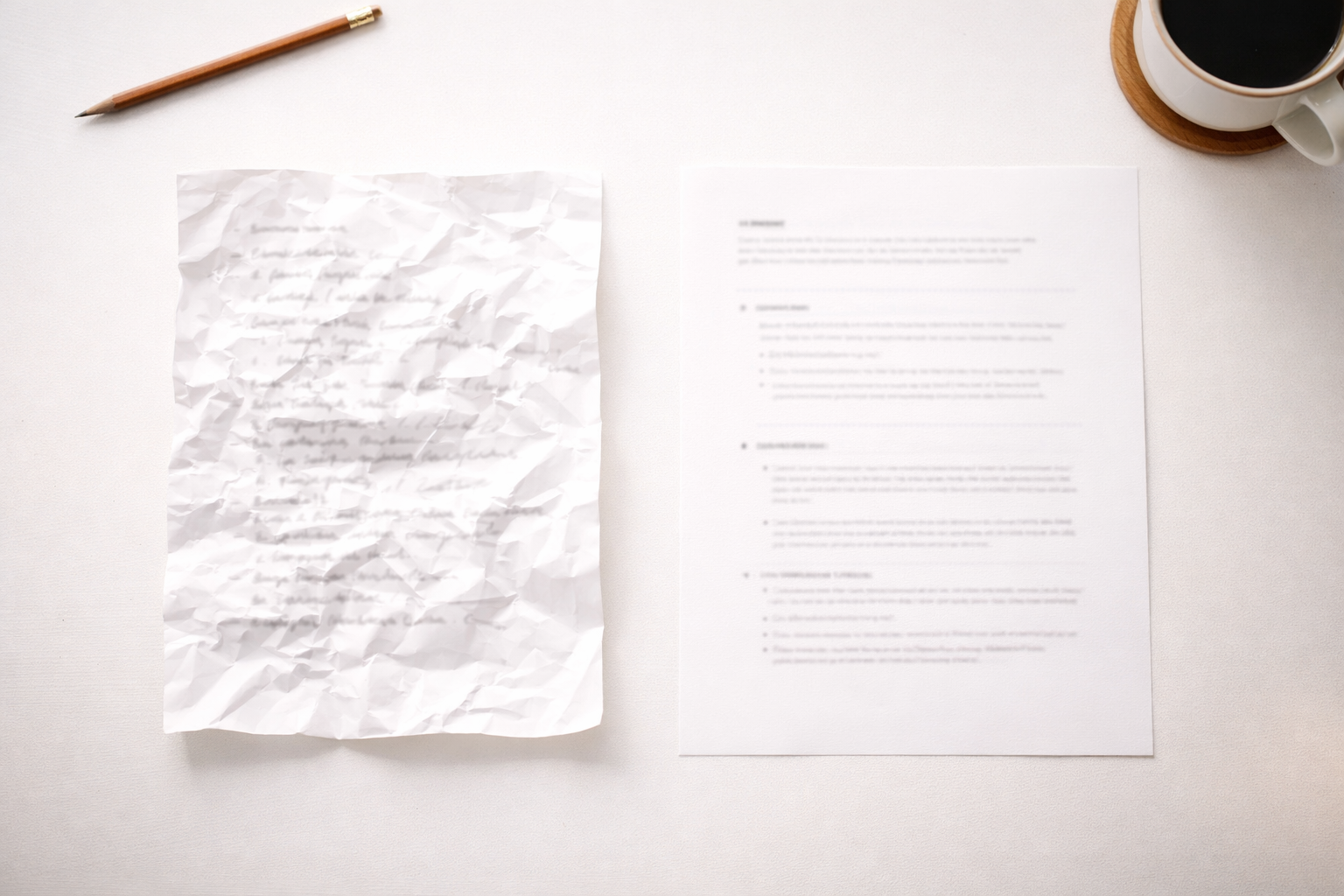
AI builds the scaffold — the specific facts and your editorial judgment complete the document
Step 4: Calibration Check
If you have a team, your reviews need to be consistent across people. Bias creeps in — you write more forgivingly for people you like, more harshly for people you've had friction with, more specifically for people who remind you of yourself.
Run a calibration check before you finalize.
Paste this prompt:
"I'm going to paste [N] performance reviews I've written for different members of my team. For each one, identify:
1. Reviews where the language is noticeably warmer or colder than the others
2. Reviews where the evidence standard is inconsistent — where I've made general claims in one but specific claims in another for similar behaviors
3. Any patterns in who gets specific development feedback vs. vague encouragement
Don't rewrite anything yet. Just flag the inconsistencies.
[paste all reviews]"
This is the most uncomfortable step. It usually surfaces something you'd rather not see. Do it anyway — your direct reports compare notes.
Step 5: Development Section
Most performance reviews write the development section last and give it the least thought. It's usually a list of vague aspirations: "Continue to develop executive presence," "Grow into more strategic thinking."
This is where the review actually matters to the person's career.
Paste this prompt:
"Based on the development areas we've identified for [name/role], help me write a growth section that:
1. Names the specific behavior or skill to develop (not a personality trait)
2. Explains why it matters — what it unlocks for them or for the team
3. Names one concrete thing they can do in the next 90 days to practice it
4. Names one thing I will do to support it
Maximum 3 development areas. Don't repeat what's already in the 'needs to grow' section verbatim."
The "one thing I will do" clause matters. A development plan where everything falls to the employee is a checklist, not a plan.
Vague (what most reviews say)
"Mia should continue to develop her executive presence and become more comfortable with senior stakeholder communication."
Specific (what this workflow produces)
"Mia consistently prepares strong analysis but defaults to presenting options rather than a recommendation when she's in the room with VPs. In Q3, she'll take point on presenting to the exec team at least twice — I'll give her a pre-brief before each one and debrief immediately after."
The vague version tells Mia she's somehow lacking. The specific version tells her exactly what to practice, when, and what support she can expect. One is noise. The other is a career conversation.
The same precision that makes a great development section makes a difficult performance conversation far more productive — you're working from the same evidence, not hedging around it.

The development section is where the review matters most to the person's career — vague aspirations help no one
What AI Should Not Do Here
Clarity on this matters — especially if you're introducing this workflow to your team or defending it to HR.
AI should not decide the performance rating. The rating is your judgment. AI organizes your evidence and helps you articulate your reasoning. If you're using it to arrive at a conclusion you haven't already reached, you're outsourcing the accountability that's yours.
AI should not soften hard truths. The instinct to ask it to "make this gentler" usually produces the same problem you started with — a review that doesn't tell the person anything real. Write the hard version first. Then ask AI to make it direct and human, not to sand off the edges.
AI should not replace the conversation. The review document is not the review. It's the record of what you've already communicated. If the most important feedback in that document is feedback the person hasn't heard before, the problem isn't the writing — it's the 1:1s that didn't happen.
AI should not handle what requires HR. Anything involving a performance improvement plan, a documented formal warning, or potential legal exposure should go through HR before AI touches the language. This workflow is for standard performance documentation, not structured underperformance management.
Where This Breaks Down
You don't have enough notes. If you're starting from memory with no documentation, AI can't manufacture evidence. The fix is upstream — build a note-taking habit during the quarter, not the week before reviews are due. A 2-minute 1:1 debrief note per week is enough. If you're in this situation now, go back to the people who worked closest with this person and ask for two or three specific examples before you start.
The person is going to be surprised. If the review contains feedback the person is hearing for the first time, AI didn't cause that problem. The review shouldn't be the first conversation. Specific feedback belongs in 1:1s throughout the quarter; the review consolidates it.
You're avoiding the hard feedback. This is the most common failure mode and the hardest to diagnose in yourself. You have the notes. The evidence is there. But you're asking the AI to soften, hedge, or reframe in ways that obscure what you actually think. If you're on your fourth revision of a development section and it still doesn't feel honest, the problem isn't the writing.
The person is a high performer with a serious behavior problem. Strong output and destabilizing behavior create a genuinely difficult review to write. AI will try to balance both, which can undersell the behavior problem because the performance data is strong. Be explicit in your prompt: "This person has strong delivery results and a documented pattern of [behavior]. I need the review to reflect both with equal weight — not to bury the behavior in the strengths."
Stakeholders gave you conflicting feedback. One skip-level loves them. A peer lead says they're hard to work with. Name the conflict explicitly in your notes, tell the AI you're working with contradictory input, and ask it to help you draft a development section that acknowledges the pattern without over-indexing on one source. Don't let the AI pick a side — that's your job.
You're reviewing someone difficult to be honest about. Either because you genuinely like them and want to protect them, or because you have a complicated history and worry about appearing biased. Recognize the distortion before you start. One useful prompt: "Tell me where I've been less specific than in the other reviews, and where I've used language that softens a concern rather than names it."
The Toolkit That Goes Deeper
The review workflow above handles the writing. If you're also responsible for AI-assisted hiring decisions, the same articulation discipline applies — both require translating incomplete signals into clear, defensible judgments.
The full People & Performance prompt library is in the Toolkit.
15 prompts covering performance reviews, 1:1 coaching conversations, hiring decisions, and restructuring communications — plus Workflow 08, the complete performance management cycle from goal-setting through review delivery.
$67. One purchase. No subscription.
Get the Executive AI Toolkit — $67Free guide + weekly newsletter
Get Started with AI in One Day — Free
Subscribe and get our free 15-page starter guide instantly. Then weekly AI workflows, honest tool takes, and strategies for senior professionals. No fluff. Unsubscribe any time.
Keep reading