AI Prompts for CFOs: 12 for Budget, Close, and Board
Twelve paste-ready AI prompts for CFOs and finance leaders — budget defence, flux commentary, board narrative, and cash. Built for numbers you have to stand behind.
Most finance leaders piloting AI get stuck in the same place: the obvious use cases all involve numbers, and numbers are the one thing you cannot afford the model to get wrong. So the pilot stalls.
These AI prompts for CFOs work the other way round. Every one holds to a single rule — the model never derives a figure you rely on. It works on the reasoning, the narrative, and the questions around numbers you have already validated. Written for Claude, they work with ChatGPT, Copilot, and Gemini.
Before you paste anything. Several prompts below say [paste] beside things like pre-close variance data and commercial contracts. Use an enterprise tier covered by a data processing agreement — Claude for Work, ChatGPT Enterprise, Copilot with commercial data protection, or Gemini for Workspace — not a personal consumer account. Do not paste material non-public information, pre-release results, or counterparty-confidential terms into a consumer chatbot. Assume your AI chat logs are records subject to your retention schedule and, in a listed company, potentially discoverable. The full governance section is at the end.
What's covered: Twelve prompts across three scenarios — budget and planning, close and board reporting, and analysis and decision support. Each has the situation, a paste-ready prompt, and a short note on why it works. Six carry an example output.
What's not covered: Anything asking a model to calculate, reconcile, or determine accounting treatment.
About the example outputs: Where this article shows one, it is a written example of the shape a good response takes — not a transcript, and not client data. The figures in them are invented for illustration.
One amplifier. Paste this ahead of any prompt below: "You are working with a CFO. Do not recalculate, estimate, extrapolate, or introduce any number I have not given you. Interrogate reasoning, surface what a sceptical board member would attack, and tell me what is missing. If a claim in my input is unsupported by what I have provided, say so rather than filling the gap." For Prompts 5, 7, 8, 11 and 12, where the figures are your own validated numbers, add: "Assume the figures I supply are already validated." Leave that line out everywhere else — in Prompts 2 and 9 the input is someone else's advocacy document, and the whole point is that it may not hold up.
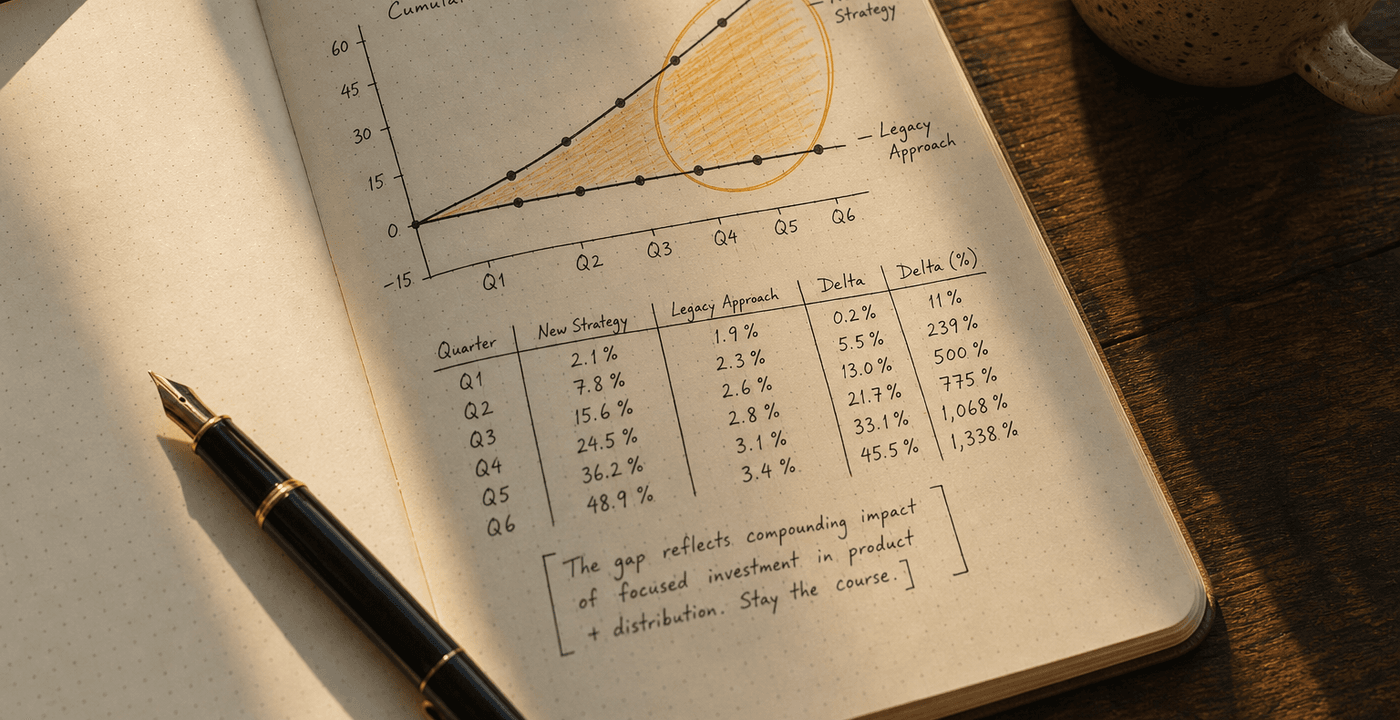
AI prompts for CFOs work best on the reasoning around numbers you have already validated
AI prompts for budget and planning (Prompts 1–4)
Budget season is repetitive and politically sensitive at the same time, which is the worst combination for a finance leader's calendar.
Prompt 1: Attack the join between cost and plan
Situation: You're defending a budget and want to find the weak seam before a director does.
Do not evaluate whether the amount is reasonable. Examine only the consistency between these three documents. Identify: (1) every place where the cost budget assumes something the revenue or headcount plan does not support, (2) which inconsistency is most visible to someone reading all three, (3) what a director concludes about how this budget was built if they spot it, and (4) the reconciling fact I would need to close each gap.
Why it works: Budget defences rarely fail on the headline number. They fail where two documents that should agree don't, so this points the model at the seam rather than the total.
Prompt 2: Separate the real asks from the padding
Situation: Submissions from every department head, limited time to work out which are genuine.
Do not assess whether the amounts are reasonable — I have that context and you do not. Assess only the quality of the reasoning attached to each. These are advocacy documents; treat their claims as unverified and do not infer history I have not given you.
Submissions: [paste]
Why it works: It constrains the model to the one thing it can genuinely assess — argument quality — instead of inviting an opinion on figures it cannot verify.
Prompt 3: Model the trade-off, not the cut
Situation: You've been told to find a reduction and want to present choices, not a unilateral decision.
Do not recommend a cut and do not total anything. Construct three coherent scenarios at the required reduction: one protecting near-term revenue, one protecting long-term capability, one protecting headcount. For each, state what the organisation gives up, what becomes impossible, which committed costs constrain it, and the single assumption it depends on. Use my figures exactly as given.
Components: [paste]
Why it works: Three scenarios with named trade-offs turn a finance decision into a leadership conversation. Flagging committed versus discretionary stops the model proposing reductions you cannot legally make.
Prompt 4: Interrogate a forecast driver
Situation: A forecast rests on a driver you suspect nobody has genuinely challenged.
Do not calculate anything. Give me: (1) the three conditions that must hold for this driver to be correct, (2) which is least within our control, (3) the leading indicator that would show it breaking and how far ahead of the outcome it moves, (4) who outside finance owns that indicator today, and (5) what a short-seller or an acquirer's diligence team would say about this assumption.
If the driver as I've stated it conflates two separate things, say so before answering.
Why it works: The sensitivity maths is a spreadsheet job. The model's value is naming the conditions, the tell, and the owner — the parts that don't live in the model and usually aren't written down anywhere.
The Executive AI Toolkit — 100 prompts across seven sections built for executive work, including the role calibrations that make outputs like these sharper. $67, one purchase, no subscription.
Get the toolkit — $67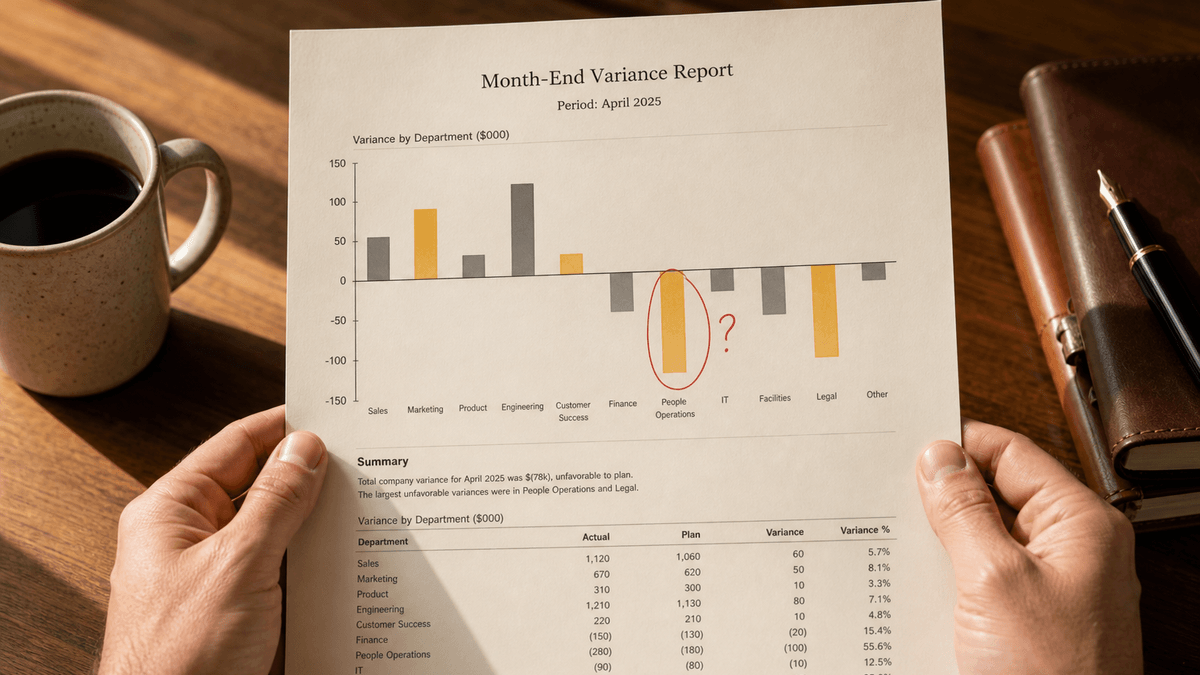
Flux commentary and board narrative are the sensible first target — the figures already exist
AI prompts for close and board reporting (Prompts 5–8)
Flux commentary and board narrative are structured, repetitive, and built on figures that already exist and have already been signed off. That combination is what makes them the sensible first target: the judgement stays with you, the blank page does not.
Prompt 5: Turn variance into board narrative
Situation: You have the variance table and need the commentary that sits above it.
Write the narrative commentary for the board pack.
Rules: reference only the figures and context I have supplied, and compute nothing. Order items by how much each bears on the decisions I listed, not by size. For each, give what happened, why, and what we are doing, in one sentence each. No hedging. Where a variance has no explanation established in what I've given you, write "driver not established" — do not speculate about causes or about board history I have not provided.
Variance data: [paste]
Why it works: The instruction to admit ignorance is the most valuable line in the prompt. Supplying the board's actual decisions is what lets the model order by relevance without inventing context — without that input it will invent it.
Prompt 6: Build the flux enquiry list
Situation: Month-end close, account-level flux explanations due.
For each movement above threshold: (1) restate the movement using my figures exactly as given, (2) list the two or three categories of cause that could produce a movement of this direction and shape in this account type, (3) name the specific evidence that would confirm or eliminate each, and (4) flag any movement whose direction is inconsistent with the others.
Do not assert which cause applies. Produce the enquiry list my team works through.
Movements: [paste]
Why it works: It converts flux from a writing task into a directed enquiry list, and the inconsistency flag is where genuine posting errors surface. The output is questions for your team, not commentary you would file.
Prompt 7: Compress for ninety seconds of attention
Situation: A detailed analysis and a board that will give it ninety seconds.
Reproduce every figure exactly as written — do not round, convert, or derive. If compression would drop a material caveat, keep the caveat and cut something else. List anything you cut that I might disagree with cutting.
Analysis: [paste]
Why it works: The reproduce-exactly instruction is the guardrail, and the final line hands back the editorial decisions the model made on your behalf instead of burying them.
Prompt 8: Build the covenant headroom brief
Situation: You need a defensible one-pager on liquidity and covenant position before someone asks for it.
Do not model or project anything. Produce a briefing note structured as: (1) each covenant, its current headroom, and the operational event that would consume that headroom fastest, (2) for each, which business owner controls that event, (3) the reporting lag between the event occurring and finance seeing it, and (4) the three facts a lender would ask for that are not in what I have given you.
Point (4) matters most — tell me what is missing from my own brief.
Why it works: Point 4 inverts the usual output. You are not asking for a summary of what you already know; you are asking what a counterparty would notice you hadn't addressed.
AI prompts for analysis and decision support (Prompts 9–12)
The reading, comparing, and interrogating that fills the gap between close and board meeting.
Prompt 9: Find the load-bearing assumption in a business case
Situation: A department head has submitted a case and you need the assumption everything rests on.
Identify: (1) the single assumption the entire case depends on, (2) whether it is supported by evidence, merely asserted, or absent, (3) the three inputs most likely to be optimistic and what a credible version of each would demonstrate, and (4) the one question that, answered honestly, tells me whether this is worth funding.
Do not rebuild or recalculate the model. Assess the reasoning and the evidence behind the inputs.
Case: [paste]
Why it works: It goes at the load-bearing assumption instead of reviewing the document top to bottom. If you are on the other side of this — writing the case rather than reviewing it — the AI workflow for business case writing covers that side.
Prompt 10: Read a contract for commercial exposure
Situation: You want the commercial shape of an agreement before it reaches legal.
Quote the exact clause text for every item. If you cannot quote it, do not report it. For (5), flag and route — do not opine on the treatment. Flag ambiguity for legal rather than resolving it.
Agreement: [paste]
Why it works: Requiring a quotation for every finding makes the output checkable in under a minute — which matters, because contract extraction is a known weak spot and this prompt does surface figures. Verify each against the quoted clause before relying on any of them. On point (5): revenue recognition and lease classification are accounting treatment, which sits outside what any general-purpose model should be deciding.
Prompt 11: Identify which revenue decomposition your data supports
Situation: Revenue moved and you want to know which analysis will actually settle why.
Do not compute anything and do not tell me which cause applies. Tell me: (1) which decompositions the data I have provided can actually support — price, volume, mix, new versus existing, churn — and which it cannot, (2) for each unsupported one, the specific additional cut I would need, and (3) where two effects are confounded in my current data such that no decomposition separates them.
Data: [paste]
Why it works: Price-volume-mix is where finance conversations either become precise or stay vague. The output is a list of cuts to run, not conclusions to trust — which is the correct division of labour.
Prompt 12: Pressure-test the 13-week cash view
Situation: You have a rolling cash forecast and want to know which line breaks it.
Do not recalculate or re-project. For each of the five largest lines: (1) name the assumption it depends on, (2) classify it as contractual, historical, or hopeful, (3) identify who outside finance controls whether it holds, and (4) give the earliest observable signal it is slipping.
Then, on judgement rather than calculation: which line would cause the most operational disruption if it landed two weeks late, given the fixed obligations I have listed, and what would we see first?
Forecast: [paste]
Why it works: The contractual/historical/hopeful classification is the useful part. A cash forecast usually contains at least one line quietly in the third category, and naming it out loud is often the whole exercise.

The line you draw is what separates deliberate adoption from it happening anyway
What AI should not touch in finance
Every prompt above is constrained to reasoning, narrative, and questioning. None asks a model to derive a figure you would rely on — Prompt 10 extracts figures, which is why it requires a verbatim quotation for each one so you can check it against the source in seconds.
That constraint reflects what these systems are built to do. They generate fluent output regardless of whether the underlying operation was sound, which means a wrong number arrives looking exactly like a right one.
Do not use a general-purpose model to calculate or reconcile figures that will be relied upon, determine accounting treatment, produce anything entering a statutory filing or covenant calculation, or substitute for legal or audit review.
Four practical rules:
Use the enterprise instance. Material non-public information, pre-release results, and counterparty-confidential terms belong in a tool covered by a data processing agreement, or in no AI tool at all.
Assume the logs are records. AI chat history sits inside your retention schedule, and in a listed company it is potentially discoverable.
Raise it as a controls question early. Where AI touches a process feeding financial reporting, whether it affects your ICFR depends on materiality and how the control is designed — a conversation to have with your auditor before it becomes their finding rather than your decision.
Require a checkable trail. Anything relied upon needs a quoted source, or a figure you supplied yourself and can verify came back unchanged.
Drawing this line explicitly, and telling your team where it sits, is what separates a finance function using AI deliberately from one where it is happening anyway and nobody has said so.
Where CFOs should start
Pick one. Prompt 1 before your next budget conversation, or Prompt 5 before your next board pack. Run it on numbers you have already validated, and judge the output the way you would judge a first draft from a new analyst.
If it earns a place, the pattern generalises: give the model figures you already trust, and put it to work on the thinking around them.
Want the full set? The Executive AI Toolkit collects 100 prompts across strategic thinking, communication, people decisions and meeting prep — with role calibrations and a high-stakes checklist for the situations where a weak output costs you. $67, one purchase.
Get the Executive AI Toolkit — $67Related reading: the AI prompts for executives collection for general executive work — Prompt 4 here is the finance-specific version of the pressure-testing technique covered there. AI for board meeting preparation covers the meeting itself rather than the pack. And AI as a thinking partner for executives covers using AI as a challenger on decisions.
Free guide + weekly newsletter
Get Started with AI in One Day — Free
Subscribe and get our free 15-page starter guide instantly. Then weekly AI workflows, honest tool takes, and strategies for senior professionals. No fluff. Unsubscribe any time.
Keep reading