Best AI Tools for Sales Leaders and Revenue Teams (2026)
A VP of Sales, CRO, or commercial director needs a different AI stack than their reps. Six slots — pipeline intelligence, conversation intelligence, deal coaching, forecasting, prospecting, and customer comms — with honest pricing and ARR-specific recommendations.
Most "AI for sales" content is written for the rep making calls. This isn't that. You're a VP of Sales, CRO, or commercial director. You own the pipeline, you answer for the forecast, and you decide which tools the team uses.
This uses the "slots not tools" framework — each slot is a functional capability your revenue operation needs. The tool filling each slot is replaceable; the capability is not.
What's covered: AI tools for pipeline intelligence, conversation intelligence, deal coaching, forecasting, prospecting, and customer communications — evaluated for the revenue leader, not the rep.
What's not covered: Individual contributor productivity tools, basic CRM setup, or tools designed for marketing teams. This is about the stack that runs your revenue operation.

Pipeline visibility is the difference between a forecast call and a guessing session
Slot 1: Pipeline Intelligence
Your first slot is visibility — into pipeline health, deal velocity, and conversion patterns that turn your forecast call from a guessing session into a data conversation.
Walk into any forecast call knowing which deals are at genuine risk, which ones your team is optimistic about without evidence, and where to apply pressure or support.
HubSpot Sales Hub — best for most revenue teams
HubSpot wins this slot because pipeline intelligence is native, not bolted on. Deal scoring uses your historical win/loss data to flag at-risk deals before your team downplays them. Automatic email, call, and calendar sync keeps pipeline data current without manual entry — which means it's actually usable. The commercial leader dashboard surfaces pipeline vs. forecast, conversion by manager, and deal flow by source without navigation overhead.
April 2026 update: HubSpot shifted its AI agents to outcome-based pricing. On Professional, budget $150–400/month additional for AI agents; on Enterprise, $400–1,200/month depending on volume.
Pricing reality: Professional: ~$950–1,200/month all-in. Enterprise: ~$3,600–4,400/month. For a 20-person team on Professional with moderate AI agent use, budget $1,000–1,500/month.
Use HubSpot if: You're scaling from spreadsheets. Your team uses Outlook or Gmail. You need out-of-the-box reporting without a 6-month implementation project. Explore HubSpot →
Salesforce Einstein — if you're already built on it
Deeper but slower to configure. Einstein AI costs $50/user/month on top of an existing license. On Salesforce Pro ($165/user/month), you're at $215/user — roughly $5,000+/month for a 25-person team. Real cost is implementation time: 3–6 months before Einstein produces reliable predictions. If your org already has clean data and a dedicated admin, it's genuinely powerful. If you're evaluating from scratch, HubSpot delivers visibility faster.
Dynamics 365 Sales + Copilot for Sales — best for Microsoft-native enterprises
If your organization runs on Microsoft 365 — Teams for communication, Outlook for email, Azure for infrastructure — Dynamics 365 is where pipeline intelligence actually compounds. Where HubSpot and Salesforce require connectors to read email and meeting context, Dynamics 365 reads your Outlook threads, Teams meeting recaps, and calendar activity natively. Deal records update from conversations you're already having, without your reps opening a separate browser tab.
April 2026 — Autonomous agents (genuinely new): Microsoft's 2026 Release Wave 1 introduced four purpose-built sales agents that execute workflows without constant human direction:
- Sales Qualification Agent — researches and scores incoming leads using CRM signals + Microsoft Graph data, enriches records automatically, disqualifies low-intent leads without rep intervention
- Sales Close Agent — surfaces missing deal steps by stage, provides next-best-action guidance, generates deal summaries
- Sales Research Agent — converts natural language questions ("which deals are at risk this quarter?") into filtered pipeline views
- Data Entry Agent — parses uploaded files and pasted content to auto-populate CRM fields
This agentic layer is ahead of where Salesforce Einstein and HubSpot Breeze are in April 2026. It is new — deployed at scale from April 2026 — and reliability in complex enterprise environments will need field validation over the coming quarters.
Pricing reality: Sales Enterprise: $105/user/month. Copilot for Sales: $50/user/month standalone — or included at no additional cost if your org already has Microsoft 365 Copilot ($30/user/month). For a 25-person team: $3,875/month minimum, or as low as $2,625/month if bundled with M365 Copilot.
Honest limitation: Native conversation intelligence — call recording, transcription, coaching analytics — is limited compared to Gong or Fireflies. Budget for Clari Copilot ($60–110/user/month) if you need team-level call analysis on top of Dynamics.
Use Dynamics 365 if: Your org runs Microsoft 365 and Teams is your primary hub. Especially strong in financial services, manufacturing, healthcare, and professional services where Dynamics Finance & Operations (ERP) is already in place. Skip it if your team runs on Google Workspace or you need best-in-class native conversation intelligence without adding another tool.
Pipedrive AI — for lean teams under $10M ARR
AI-powered deal scoring, win probability predictions, and smart contact enrichment at $49–79/seat/month. Right when your pipeline complexity doesn't justify $1,000+/month for HubSpot Professional. You'll outgrow it by $15M ARR.
Implementation note: Whichever CRM you choose, expect 2–3 weeks before your pipeline data is reliable enough for forecast decisions. The tool doesn't matter as much as your team's discipline in stage definitions and close date accuracy.
Slot 2: Conversation Intelligence
Your reps talk to prospects all day. This slot is about whether you have visibility into what's actually being said — and whether it matches what's in your CRM. This is team-level intelligence, not individual transcription.
Gong — best for enterprise teams where deal risk matters
The category leader, priced accordingly. Unlimited recording across all customer-facing calls, AI-driven deal risk scoring, competitive intelligence extraction, and behavior analysis. Deal Boards show pipeline health based on actual conversation signals — not CRM fields your reps may or may not update.
For a 50-person team, budget $75,000–130,000/year (base platform fee + per-user + onboarding). Mandatory 2–3 year contracts. The analytics only pay off when your team actually uses them to change deal handling. Many teams buy Gong for call summaries alone — that's an expensive transcription tool.
Use Gong if: You run 50+ reps, forecast variance is costing you board meetings, and you have a strong ops team to drive adoption. Otherwise, Fireflies delivers 80% of what you need at a fraction of the cost. For the full head-to-head across Gong, Fireflies, Otter, Fathom and the no-bot options, see Best AI Meeting Assistant for Executives.
Fireflies.ai — best for mid-market teams
Fireflies delivers meeting transcription and AI summaries at a fraction of Gong's cost. $10/user/month (Pro), with AI summaries within 30 seconds of every meeting. Business tier ($19–29/user/month) adds team analytics: talk-time analysis, topic tracking, sentiment detection. CRM sync to HubSpot and Salesforce is native — call summaries push directly to deal records without rep overhead.
Critical gap vs. Gong: Fireflies does not offer deal risk scoring from conversation signals. You get summaries and talk ratios, not "this deal is at risk because you haven't heard budget confirmation in three calls." If your reps update deal stages consistently and you use a strong qualification rubric (Slot 3), Fireflies is enough. If your reps are optimistic deal updaters, you need Gong.
Pricing reality: For a 50-person team on Business tier, roughly $1,500–2,000/month all-in — vs. Gong's $6,000–11,000/month. You're buying a different product tier, not just a cheaper version of the same thing.
Fathom — free entry point, limited team value
Free unlimited recording with 5 AI summaries per month. Solid individual productivity tool, not a team intelligence platform — no deal-level analytics, no cross-conversation pattern detection, no manager dashboard. Start your reps on Fathom if they have no meeting recording today, then upgrade to Fireflies or Gong when you need team-level visibility.
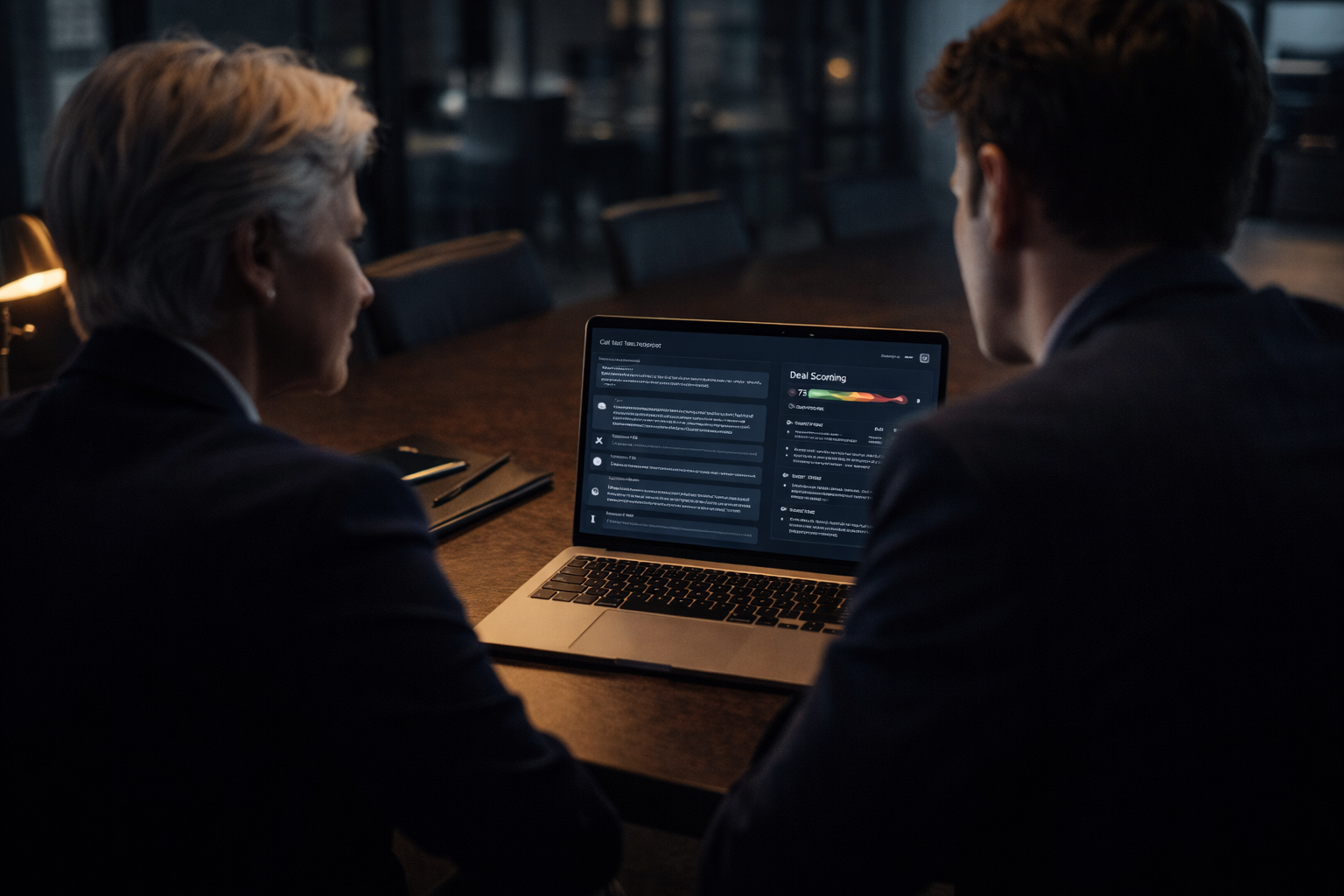
Deal qualification is a team discipline, not an individual judgment call
Slot 3: Deal Coaching and Qualification
You have reps who bring deals in consistently. You also have reps whose deals fall apart at contract stage. The difference isn't motivation — it's decision quality during qualification.
Before a rep commits resources (demo, POC, executive involvement), they need to walk through hard criteria: Who's the actual buyer? Is budget confirmed or assumed? Most reps get this wrong because they've invested time and optimism.
Build your own deal qualification rubric with AI
Third-party coaching tools (Gong coaching, Seismic, Highspot) focus on rep behavior — talk patterns, content usage, call structure. Useful for coaching the rep, not evaluating the deal. What you need is a fast, consistent way to pressure-test deal logic before your team burns cycles on dead opportunities. The solution: a structured prompt in Claude or ChatGPT that scores deals against criteria from your own win/loss data. Cost: $0 beyond your existing AI subscription.
Extract 5–7 criteria from your last 20 closed-won and 20 closed-lost deals. Which factors actually predicted the outcome? Run them through the criteria. Calibrate until the rubric predicts 70%+ of outcomes correctly. Refresh quarterly.
Worked example
A VP of Sales at a mid-market SaaS company ($15M ARR, 30-person team) built a rubric from 6 months of win/loss analysis and tested it on 40 historical deals (accuracy: 72%). In Month 1, the rubric flagged 3 active deals where "approved budget" meant one approver had signed off — not the three signatures required for procurement. All three later stalled at contract. By Q3, forecast variance tightened from ±28% to ±15%. The rubric worked because it was grounded in that company's deal history, not a generic sales methodology.
Paste-ready prompt
You are a deal analyst. I will paste notes from a sales deal. Score it against this rubric:
Rubric:
- Champion identified and actively engaged: Yes/No
- Budget confirmed by finance/procurement (not sponsor-only): Yes/No
- Implementation timeline documented with dates: Yes/No
- Competitive landscape: Greenfield / Displacement / Multi-vendor eval
- Procurement/legal process and timeline mapped: Yes/No
For each criterion, cite the specific evidence from the deal notes. If evidence is absent, score No. At the end, give a Pass/Review/Escalate recommendation and one specific question the rep should answer before the next call.
Deal notes: [PASTE NOTES HERE]
When to add Gong coaching on top: If you run 50+ reps and want to know why certain reps qualify better, Gong's conversation analytics layer shows you the behavioral patterns. The rubric tells you what questions to ask; Gong tells you who asks them well.
Slot 4: Revenue Forecasting
Most sales forecasts are right to within 30% — wrong enough to break board meetings. You need a model that learns from your actual deal behavior, not industry benchmarks.
Critical prerequisite: No forecasting tool fixes bad data hygiene. If your reps move close dates in bulk every quarter or skip next-step fields, the fanciest AI can't help. Before buying Clari or Gong Forecast, commit to weekly forecast calls where reps explain stage changes and monthly close-date sanity checks.
Under $10M ARR: Build your own model
Export stage timing data from your CRM, paste it into Claude: "Analyze this pipeline data. Which patterns predict closure? Which patterns predict lost deals?" The AI identifies your deal behavior in under 5 minutes — but only if your CRM data is consistent. Many early-stage teams have dirty data (deals sit in stages for months, close dates updated retroactively). Spend 2–3 weeks cleaning stage definitions first. Cost: $0 beyond your AI subscription.
$10M–$50M ARR: HubSpot AI forecasting or Gong Forecast
HubSpot: Predictive forecasting on Enterprise uses historical pipeline data to generate weighted forecasts. Works well if your data is clean. Many mid-market teams find this sufficient combined with Slot 1 visibility.
Gong Forecast: Models deal progression from conversation signals — sees "no budget confirmation in 3 calls" as a risk signal that HubSpot won't detect. More powerful, but requires 30–60 days of conversation data before the model is reliable.
$50M+ ARR: Clari or Aviso
Clari (Gartner Magic Quadrant Leader, December 2025) integrates CRM data, conversation signals, email patterns, and calendar activity to model deal progression. Clari Core runs ~$100–125/user/month. Add Copilot and Groove for a 100-person deployment: $150,000–300,000/year. For organizations where a 5% forecast accuracy improvement materially affects board confidence, it pays for itself. Clari's accuracy claims depend on data quality — a company with 8-stage pipelines and manual stage hygiene will see lower accuracy than their marketing suggests. Aviso competes directly and adds consumption forecasting for usage-based pricing models.
If your CRM is Dynamics 365 Sales Enterprise or Premium: the built-in AI forecasting — multi-hierarchy rollups by territory, product, business unit, and manager — is strong enough for most enterprise revenue leaders without buying Clari. Copilot for Sales layers deal risk signals on top. Only move to Clari if you need forecasting that integrates conversation intelligence data beyond what Dynamics captures natively.
People.ai fills a different niche: automated activity capture and account-level engagement scoring. If your sales motion is account-based, People.ai shows which accounts are getting real attention and which are being neglected — data your CRM doesn't capture. Starting ~$50/user/month, it's a complement to Clari, not a replacement.
Slot 5: Prospecting and Lead Intelligence
Your reps need pipeline to work. This slot is about the tools that help them find, research, and reach the right people — and your job as a leader is to pick the approach that matches your sales motion.
Apollo.io — best for volume prospecting
275M+ contacts. Advanced filtering by title, seniority, company size, and intent signals. Built-in email sequences with A/B testing. Pricing: Basic $49/month, Professional $79/month. For a 20-person team on Professional, budget ~$19,000/year. Right when your sales motion depends on volume — high outbound, broad market, transactional deals. Pair with LinkedIn Sales Navigator for the relationship layer.
LinkedIn Sales Navigator — best for relationship-based selling
Account IQ surfaces real-time account insights (strategic priorities, org structure) from LinkedIn data and third-party sources. Relationship Explorer identifies warm internal paths to target accounts — invaluable when cold outbound fails. Pricing: Core $99/month, Advanced $159/month (includes AI features). Non-negotiable if your reps sell into enterprise accounts where the relationship precedes the deal. Note: LinkedIn data is sparse for manufacturing, logistics, or construction — pair with Apollo or Clay for those verticals.
Clay — best for enrichment and creative prospecting
Not a contact database — an enrichment platform. Pulls from 75+ data providers using a waterfall approach. Claygent, its AI research agent, handles prospect research that static databases can't. Pricing: Launch $185/month, Growth $495/month. March 2026 update dropped data marketplace costs by 50–90%. Right when your outbound team needs personalization that generic databases can't provide. Power tool — expect a learning curve.
ZoomInfo — enterprise B2B data
The most comprehensive B2B database: technographics, department budgets, org charts, real-time event alerts. ZoomInfo Copilot (new) provides AI-assisted deal closing recommendations. Pricing: $30,000–60,000/year. Mandatory annual contracts with 10–20% auto-renewal increases. Skip ZoomInfo if you're under $20M ARR — Apollo or Clay deliver 80% of the value at 20% of the cost.
Slot 6: Customer Communications at Scale
Your reps send emails that sound like form letters. This slot bridges the gap between generic outbound and contextual, deal-relevant communication.
Claude or ChatGPT embedded in your workflow
The highest-value communication tool is the AI you already pay for — embedded in your team's workflow. A rep finishes a discovery call, pastes notes into a prompt, and gets a personalized follow-up in 30 seconds. Claude's 200K-token context window makes it particularly useful for processing long deal histories or full call transcripts. ChatGPT integrates more easily into existing enterprise tools and has a lower friction adoption curve. Pick one and build your prompts around it — the prompts work with Claude, ChatGPT, Copilot, and Gemini.
Paste-ready discovery follow-up prompt
You are a B2B sales professional. You just completed a discovery call. Write a follow-up email (150–200 words) that: (1) Confirms what you learned about their specific pain, (2) Shows you understand their process — reference something they said, (3) Asks one clarifying question that uncovers a buying signal, (4) Sets a specific next step with a date.
Call notes: [PASTE NOTES HERE]
Your product/service: [ONE-LINE DESCRIPTION]
Prospect's name and title: [NAME, TITLE]
Adoption note: Embed the prompt in Slack or your CRM — not a separate tab. Redact customer PII before pasting. 90-second review before sending.
HubSpot Sequences, Outreach, Salesloft
HubSpot Sequences handles multi-touch cadences natively if you're already on HubSpot. The April 2026 update added dynamic sequences that AI-filter for warm leads. Most revenue teams under $30M ARR don't need a dedicated sales engagement platform — HubSpot Sequences + Claude for personalization covers it at a fraction of the cost. Outreach ($120+/user/month) or Salesloft ($100–175/user/month) are for 50+ reps with complex multi-channel cadences — or for rep coaching and behavior change analytics that HubSpot doesn't provide.
For deeper guidance on communications that don't sound AI-generated: AI for Executive Communication.
Critical Gap: Implementation and Adoption
Picking the right tools is 20% of the battle. The other 80% is getting your team to use them consistently.
What kills most implementations:
- Unclear mandate. If your team isn't sure whether using the new platform is required or optional, adoption stalls. Your first week needs a team meeting explaining why you bought it and what you'll measure — not a demo.
- Data hygiene exposure. When you implement HubSpot or Gong, your reps' inconsistent data habits become visible. Expect 2–4 weeks of cleanup before any tool gives you reliable insights.
- Integration friction. Test integrations in a pilot group first, not your entire team.
- Training that's forgotten by week three. Live demos work. Recorded training doesn't. Budget for ongoing rep coaching in months one and two.
Real cost example: A 10-person team that closes $200K/month and takes a 20% activity dip during Gong implementation loses $8K–12K in revenue over 2–3 weeks. Add 60 ops hours at $50/hour ($3K) and the $9K/month platform fee, and your all-in implementation cost is $20K–25K — not just the software subscription. Most revenue leaders don't account for this when evaluating tools.
Gap: Account Planning and Deal Management
If your revenue model is account-based (ABM), you need more than pipeline intelligence — you need account-level orchestration: which accounts are getting attention, which are stalled, and whether your activities are aligned to a win strategy.
- SalesIntel or Terminus — account-level intent and buying committee mapping. Layer on top of HubSpot/Salesforce to show which accounts are showing buying intent and which stakeholders need engagement. Pricing: $5,000–15,000/month.
- Clari for deal management (beyond forecasting) — tracks deal health metrics (budget confirmation, sponsor engagement, procurement status) in real-time across your entire pipeline. For a $100M+ revenue org, deal hygiene issues cost millions. Budget $150K–300K/year.
- Seismic or Highspot — content management and deal support. If your reps are asking "which deck should I use for this industry?" and getting different answers, you need a content platform that matches content to deal context. Pricing: $50–100/user/month.
These aren't universal needs — they matter if your average deal is $250K+, you have 6+ months of sales cycle, or you're competing in multi-vendor evals. Skip them under $50M ARR.
Gap: Customer Success and Sales-CS Handoff
Your deal closes. Now CS owns it — but CS doesn't know what was promised in discovery or what the customer's real pain was. Only what the contract says.
- Automatic deal recap to CS: Build a workflow in HubSpot/Salesforce that triggers on close and pulls conversation intelligence data — customer requirements, promised delivery timeline, any custom commitments. Gong has a native "send to CS" integration; Fireflies requires Zapier or custom API. Budget 2–3 hours for setup.
- Customer health scoring: Totango, Gainsight, and Vitally alert CS when signals indicate churn risk (low feature adoption, budget constraints mentioned in conversations). Most CRMs don't do this natively — it's a separate platform if CS handoff is a priority.
Under $50M ARR, this is "nice to have." At scale, poor sales-CS handoff costs 5–10% of your renewal rate.
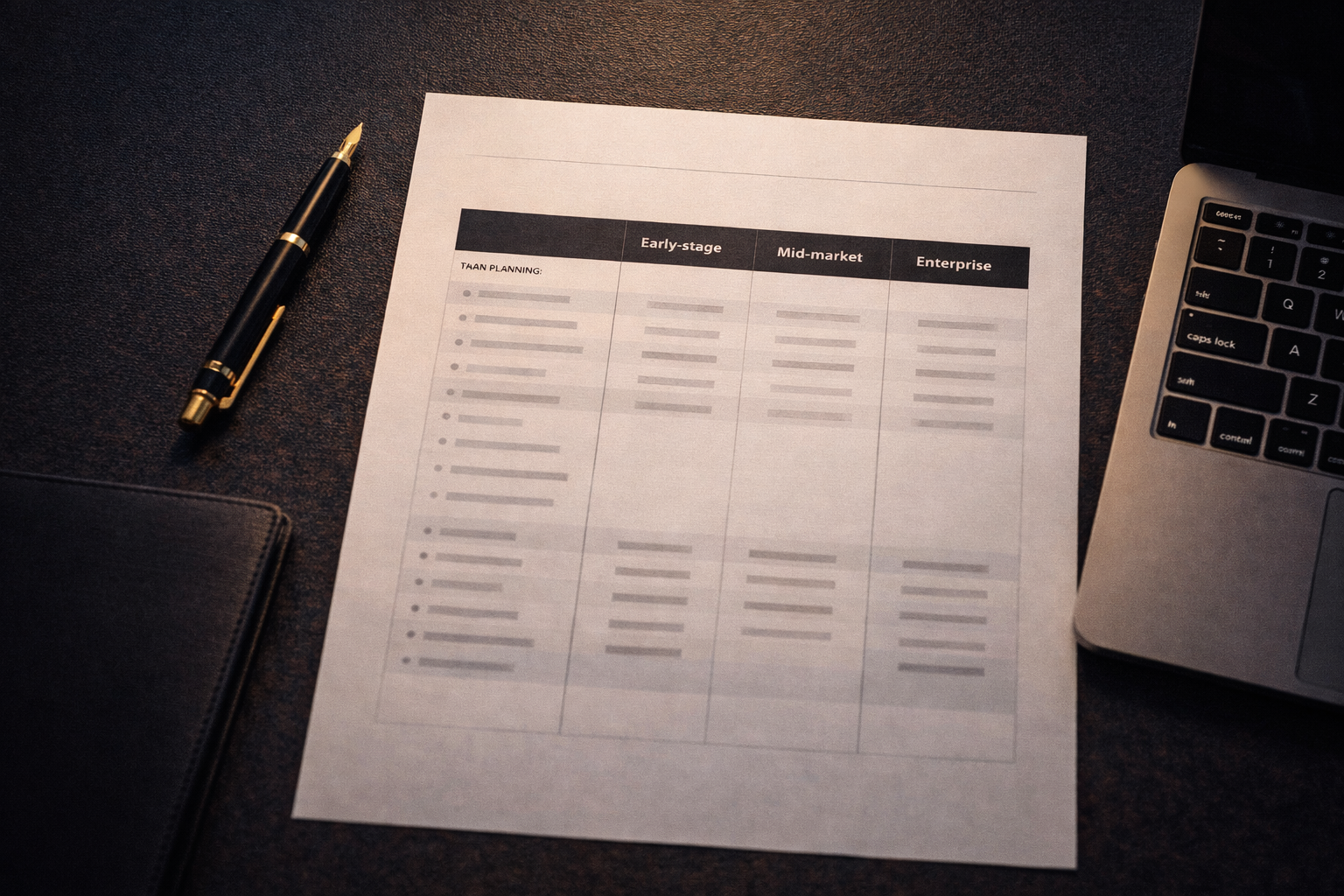
Fill the slot first — upgrade the tool when you outgrow it
Putting It Together: Your Stack by ARR
Early-stage ($1–10M ARR) — budget: $2,000–2,400/month
Example: 15-person team, 8 sales reps
- Pipeline: HubSpot Professional ($950–1,200/month with AI agents)
- Conversations: Fireflies Business, 8 reps ($152–232/month)
- Deal coaching: Internal AI rubric (free)
- Forecasting: DIY model with Claude/ChatGPT (free)
- Prospecting: Apollo Professional + LinkedIn Sales Navigator Core (~$730/month)
- Communications: Claude or ChatGPT Pro ($20/month) in Slack
Mid-market ($10–50M ARR) — budget: $6,500–15,000/month
Example: 30-person team, 20 sales reps
- Pipeline: HubSpot Enterprise ($3,600–4,400/month) or Salesforce + Einstein (~$5,000+)
- Conversations: Fireflies Business ($380–580/month) OR Gong ($8,000–12,000/month)
- Forecasting: HubSpot AI forecasting or Gong Forecast add-on
- Prospecting: Apollo Organization + LinkedIn Sales Navigator Advanced (~$5,560/month) + Clay for top accounts
- Communications: Claude/ChatGPT + HubSpot Sequences OR Outreach Essentials ($2,400/month)
At this scale, conversation intelligence drives your entire stack cost. Fireflies keeps you under $8,500/month; Gong pushes you to $12,000–15,000/month. The difference is deal risk scoring — decide if you actually need it.
Enterprise ($50M+ ARR) — budget: $25,000–60,000/month
Example: 100-person team, 60 sales reps. Three realistic paths depending on your existing tech stack:
Path A — Salesforce stack:
- Pipeline: Salesforce + Einstein ($10,000–12,000/month)
- Conversations: Gong ($9,000–15,000/month)
- Forecasting: Clari ($18,000–36,000/month) or Aviso
- Prospecting: ZoomInfo + LinkedIn Sales Navigator Advanced Plus
- Engagement: Outreach ($7,200/month) or Salesloft ($6,000–10,500/month)
- Total: ~$40,000–60,000/month
Path B — Microsoft stack (Dynamics 365):
- Pipeline + Forecasting: Dynamics 365 Sales Enterprise + Copilot for Sales ($6,300–9,300/month for 60 reps, lower if bundled with M365 Copilot)
- Conversations: Clari Copilot for call intelligence ($3,600–6,600/month) — required since D365 native CI is limited
- Prospecting: ZoomInfo + LinkedIn Sales Navigator Advanced Plus
- Engagement: Outreach or Salesloft
- Total: ~$25,000–45,000/month — lower than Salesforce, especially if your org already has M365 Copilot licenses
- Best for: financial services, manufacturing, healthcare, professional services — any org where Dynamics 365 Finance & Operations or Teams is already the operational backbone
Path C — HubSpot stack:
- Pipeline: HubSpot Enterprise ($7,500+/month with AI agents)
- Conversations: Gong or Fireflies Business (scale based on need)
- Forecasting: HubSpot AI forecasting or Gong Forecast add-on
- Prospecting: ZoomInfo or Apollo + LinkedIn Sales Navigator
- Engagement: Outreach or HubSpot Sequences + Claude/ChatGPT
- Total: ~$20,000–40,000/month
- Best for: revenue-led orgs scaling quickly without a legacy enterprise system. Strong on speed-to-value, weaker on deep customization
At enterprise scale, your CRM choice is rarely made from scratch — you're usually already on one of these three platforms. The decision is whether your current stack's AI features are sufficient or whether you need best-of-breed tools layered on top. In the Microsoft stack particularly, the new autonomous agents (April 2026) may reduce the need for standalone forecasting tools — if they prove reliable at scale.
One thing the tool stack never replaces: the prep you do before a high-stakes deal conversation. For the BATNA model, concession mapping, and language for common pushback, see AI Negotiation Prep for Executives.
The Executive AI Toolkit is built for revenue leaders.
Includes the Commercial Leader role calibration prompt (built for sales leadership scenarios), 15 Stakeholder Management prompts for navigating complex deals, and 12 Negotiation prompts for contract and vendor discussions — all paste-ready.
$67. One purchase. No subscription.
Get the Executive AI Toolkit — $67Free guide + weekly newsletter
Get Started with AI in One Day — Free
Subscribe and get our free 15-page starter guide instantly. Then weekly AI workflows, honest tool takes, and strategies for senior professionals. No fluff. Unsubscribe any time.
Keep reading